Revit API units: convert once, verify twice
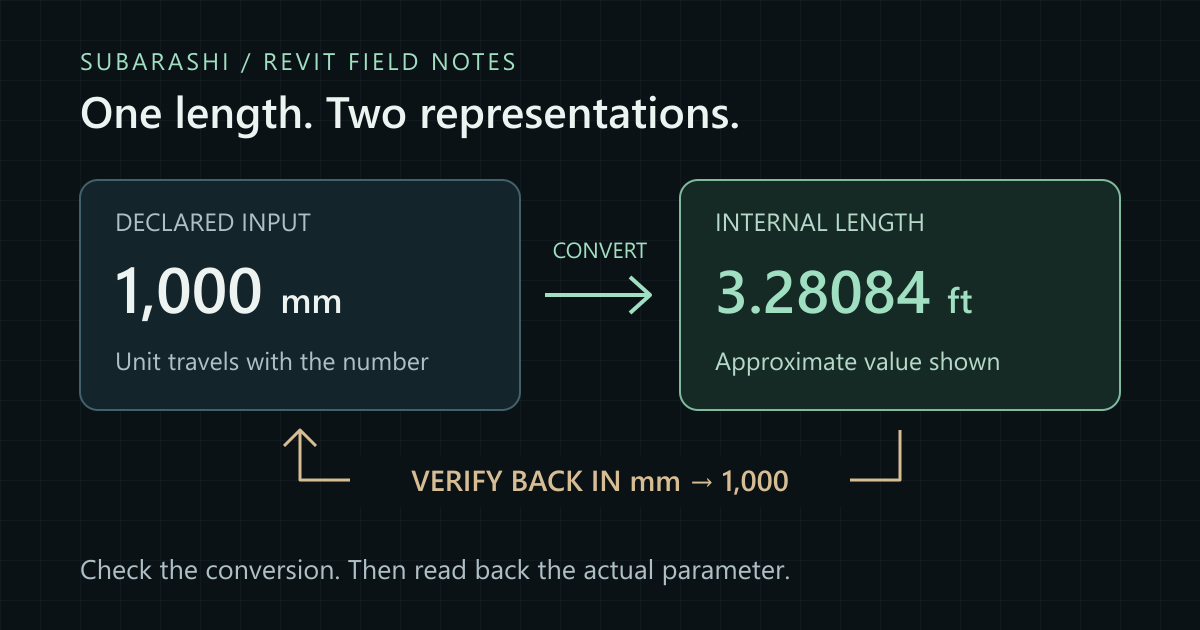
A 1,000 mm input can become 304.8 metres if a Revit script treats it as an internal length. Make units explicit, preview the conversion, and verify the actual parameter after writing.
 AhmedRevit
Owner / field desk
Ahmed owns the site and turns field-tested work into reusable notes for builders, BIM leads, and tool-minded teams.
A 1,000 mm input can become 304.8 metres if a Revit script treats it as an internal length. Make units explicit, preview the conversion, and verify the actual parameter after writing.
AhmedRevitA practical development loop for AI coding agents: define acceptance criteria, make a bounded change, inspect evidence, and decide when to repair, stop, or ship.
AhmedAIA running log of the moments where Ahmed's hands-on BIM experience beat the model's confident generalizations, starting with Revit journal save history.
AhmedRevitA field note on how to ask AI coding agents to copy useful tools between projects without crossing manifests, namespaces, IDs, deployment paths, or ownership boundaries.
AhmedAI
A field note on what the C:\Autodesk\WI folder is, why Autodesk installer files can pile up, and what I checked before cleaning disk space.
AhmedRevit
Ahmed explains why BIM and Revit automation is only finished when another teammate can run it safely, understand the inputs, recover from mistakes, and trust the handoff.
AhmedBIM
Ahmed and Zack explain why AI workflow demos should show the exported file, review notes, cleanup path, and handoff evidence before claiming production value.
AhmedAI
Ahmed explains why every Dynamo cleanup script needs a rollback plan before it touches live Revit models, parameters, views, or sheets.
AhmedDynamo
Ahmed explains why Revit family libraries need named ownership, standards, review gates, and retirement rules before automation starts reorganizing content.
AhmedRevit
Ahmed gives BIM, AI, and creator teams a practical decision matrix for deciding whether a tool belongs in production, stays in experiments, or gets rejected.
AhmedAI
Ahmed explains why Revit batch tools should prove themselves on a small test model before touching production files, shared standards, or live deliverables.
AhmedBIM
Ahmed explains why Revit cleanup scripts should produce reviewable reports before they rename, delete, rebind, or rewrite anything in a live model.
AhmedRevit
Ahmed explains why Revit family automation needs stable, boring naming rules before scripts, agents, or batch tools start touching production content.
AhmedRevit
Ahmed turns repeated Revit shared-parameter mistakes into a practical checklist for names, GUIDs, bindings, schedules, and team handoff.
AhmedRevit
Ahmed explains why Revit shared parameters should be treated like an interface contract between models, families, schedules, tags, exports, and automation.
AhmedBIM
Ahmed and Zack explain how to decide whether AI belongs in a BIM, Revit, 3D, or creator workflow by testing the handoff, risk, and cleanup path.
AhmedAI
Ahmed explains how a static Astro and Cloudflare blog can still run like a review-first publishing system with provenance, CI, and guarded deploys.
AhmedWorkflow
Why I'm starting a working notebook on tech, automation, AI, Revit, and BIM - and the rules I'm setting before I forget them.
AhmedWorkflow
How AI assistants draft posts for this site: a small protocol, a review-first default, and a hard line about what I sign my name to.
AhmedAI